

In food production and other hygiene-critical operations, proper cleaning is a fundamental requirement for safe and consistent production. After cleaning and rinsing, small amounts of cleaning chemicals may still remain on equipment, work surfaces, and production lines. Excessively high residue levels can affect both product quality and microbiology, while also creating problems during audits and HACCP.
Many facilities today focus on ATP microbiological testing, but it is just as important to check for chemical residues after cleaning. The question is therefore not only whether the surface is free of organic material, but also whether the cleaning chemicals have actually been rinsed off thoroughly.
Why is monitoring chemical residues important?
Alkaline cleaning agents, acids, or various types of disinfectants are often used to clean and disinfect production equipment. If rinsing is insufficient, residues can gradually build up on surfaces and equipment over time.
Excessive levels of chemical residues can affect:
- product quality
- taste and smell
- microbiological processes
- the surface layer of the equipment
- internal hygiene procedures and HACCP
In hygiene-critical operations, verifying cleaning and rinsing processes is therefore a crucial part of preventive hygiene efforts. Several manufacturers in the hygiene and disinfection sector are now also emphasizing the importance of monitoring and reducing the accumulation of chemical residues in production environments.
Why is pH measurement used?

There are several different methods for testing for detergent residues, but in practical food production, a method needs to be quick, simple, and easy to use directly on the production floor.
pH is a measure of how acidic or alkaline a solution is. Many cleaning chemicals used in food production are either alkaline or acidic, which means that residual traces can usually be detected through abnormal pH levels.
This is why pH measurement is often used as a practical routine method in HACCP internal monitoring. By taking a simple surface sample with a swab and measuring the pH of the sample liquid, it is possible to quickly detect abnormal residues of alkaline or acidic cleaning chemicals.
For many businesses, pH measurement goes a long way toward ensuring the cleaning process is properly monitored on a daily basis.
How is the sample collected?
A common approach is to first establish internal benchmarks for the process. Many facilities therefore begin by taking measurements on a surface that they know has been properly cleaned and thoroughly rinsed, in order to establish their own baseline for production.
You can also measure a surface that has been intentionally contaminated with a small amount of detergent to see what a clear positive deviation looks like in that particular environment.
Once these reference points are established, it becomes much easier to interpret future measurements and identify deviations in cleaning results. It also provides better internal traceability and can facilitate HACCP, audits, and trend monitoring over time.
In practice, sampling is often carried out as follows:
- Moisten a sterile swab or sponge with deionized or sterile water
- A defined area is wiped down, for example, 10 × 10 cm
- The collected sample is extracted from the swab using a small amount of deionized water for subsequent pH measurement
- pH is measured using a portable pH meter
If the test shows a pH level that differs significantly from that of the reference surface, this may indicate the presence of residual cleaning chemicals on the surface.

When is conductivity a good complement?
For facilities that wish to take a more advanced approach to cleaning verification, conductivity is often used as a complement to pH.
Conductivity measures the concentration of dissolved ions in the sample liquid and can therefore detect residual chemicals even when the pH is relatively close to neutral. This method is often used, for example, in:
- CIP processes
- checking the final rinse water
- trend monitoring over time
- more systematic cleaning verification
The same principle involving a baseline and reference surfaces can also be applied to conductivity measurements. By comparing clean reference surfaces with surfaces containing known amounts of cleaning chemicals, you can establish your own practical threshold values for the specific production and cleaning process.
The combination of pH and conductivity therefore provides a more comprehensive picture of the cleaning results and can be a good option for facilities with stricter requirements for hygiene monitoring and process control.

When are test strips used?
There are also test strips available for certain specific cleaning and disinfecting chemicals, such as peracetic acid, quaternary ammonium compounds, or chlorine-based processes. These can be useful when you want to monitor a specific type of chemical or meet specific audit requirements.
However, even when using chemical test strips, some form of surface sampling with a swab is often required to collect and extract samples from the surface before analysis can be performed.
For routine monitoring, many organizations therefore find that pH measurement offers a better combination of simplicity, cost-effectiveness, and practicality.
Choosing the right swab or sponge
The choice of swab or sponge is important for obtaining consistent and reproducible measurement results.
In microbiological sampling, neutralizing swabs or sponges containing various types of buffer or neutralizing media are often used. For pH and conductivity measurements, however, this is generally unsuitable because the medium itself can affect the analysis results.
For chemical residue testing, the following is therefore generally recommended:
- sterile swabs without neutralizing medium
- polyester or cellulose swabs with low environmental impact
- deionized or sterile water during sampling
Products for cleaning verification
At Hygiene Diagnostics, we offer practical solutions for monitoring cleaning processes and chemical residues in food production and other hygiene-critical operations.
For many businesses, a reliable portable pH meter is more than sufficient for daily HACCP internal monitoring. pH testing is easy to implement, quick to perform, and provides clear information about residual alkaline or acidic cleaning agents after cleaning and rinsing.For this purpose, we offer Hanna’s waterproof pH testers for routine checks right on the production floor.
For facilities that wish to take a more advanced approach to cleaning verification, there are also instruments that combine pH measurement with conductivity and TDS (Total DissolvedSolids) measurement, which can be useful, for example, in monitoring process water, CIP systems, and rinsing processes.TDS can be viewed as an alternative representation of the conductivity value.
Hanna waterproof pH/conductivity/TDS testersfor low measurement ranges are often the most relevant, since even small amounts of residual chemicals can cause measurable changes in conductivity.
We also offerNeogen’s sterile swabsfor environmental sampling, which can be used in conjunction with pH and conductivity measurements during routine hygiene monitoring.
Product suggestions:

Item No.: ECS100

Hanna® pH/EC/TDS/°C Meter (Low Range)
Quantity: 1 per packageSign in / register for pricing Read moreItem No.: HI-98129
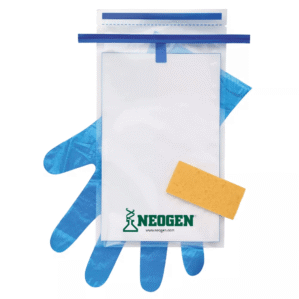
Neogen® Sponge – Sampling sponge with bag
Quantity: 100 pcs. per packSign in / register for pricing Read moreItem No.: HS10

Item No.: HI-98128
Please feel free to contact us if you need help choosing the right solution for your production, cleaning procedures, and HACCP.