

The instrument may look clean, but that does not always mean it is free of residual organic material. A new multicenter study from Terragene, conducted in collaboration with Argentina’s leading university hospitals, shows that protein residues can still be detected after standard cleaning procedures have been completed and underscores the importance of objective cleaning verification.
When "clean" Doesn't Always Mean "Clean"
Hollow instruments and other medical devices with complex geometries are among the most challenging items to clean. Narrow lumens, joints, and hard-to-reach surfaces mean that organic material may remain even when cleaning is performed according to established procedures.
This is a key reason why several guidelines and standards emphasize the importance of verifying the cleaning process and not relying solely on visual inspection.
Terragene an internationally established manufacturer of products for sterilization control and cleaning verification, with solutions used by hospitals and central sterilization departments worldwide. As part of the company’s ongoing research and development efforts, Terragene conducted a multicenter study Terragene 2026 in collaboration with Argentina’s leading university hospital. The results showed that residual protein deposits on instruments remain a real problem even after standard cleaning procedures have been completed. The study also demonstrated how objective measurements can be used to identify deviations and provide a basis for improvements to the cleaning process.
Small and complex instruments present special challenges
The study showed that instruments with narrow and long lumens pose a particular challenge from a cleaning perspective. The smaller the diameter and the more complex the geometry, the more difficult it becomes to ensure that organic material has been completely removed.
This means that an instrument may appear clean during a visual inspection but still contain residual protein that can interfere with subsequent disinfection and sterilization.
Objective measurements provide a better basis for decision-making
An important conclusion from the study is that measurements can be used as a tool for continuous improvement. In several cases, the results of the protein measurements were used as direct feedback to the central sterilization department. Instruments that showed elevated protein levels were sent back for re-cleaning and retested before they could be approved for further use.
The purpose of protein measurement is not to replace established cleaning procedures or to advocate a particular method, but to provide an objective basis for assessing how well the process works in practice.
The measurement results can be used for:
- Verification of Existing Processes
- Identification of Deviations
- Validation of Changes to Procedures
- Trend Analysis and Monitoring
- Training and Continuous Improvement
- Documentation in Quality Management Systems
ATP or protein measurement?
ATP and protein measurement should not be viewed as competing methods, but rather as tools with different strengths and applications.
ATP is often used for routine monitoring and provides rapid feedback on the presence of organic material. The method can also provide valuable information when biofilm is suspected and is therefore widely used for trend monitoring and daily process control.
Quantitative protein tests focus on residual protein, which is often considered a worst-case scenario in cleaning verification. Objective protein measurements are therefore well-suited for validation, comparative studies, and improvement efforts, but can also be used for routine monitoring.
The most appropriate method depends on the needs of the operation, the type of instrument, and the purpose of the inspection. In many cases, these methods can be used effectively to complement one another.
| Method | Typical uses | Special Unit |
|---|---|---|
| ATP measurement | Routine Checks and Trend Monitoring | Prompt feedback and information about organic material |
| Quantitative Protein Measurement | Validation, Comparative Studies, and Routine Monitoring | Objective measurement of protein residues and worst-case verification |
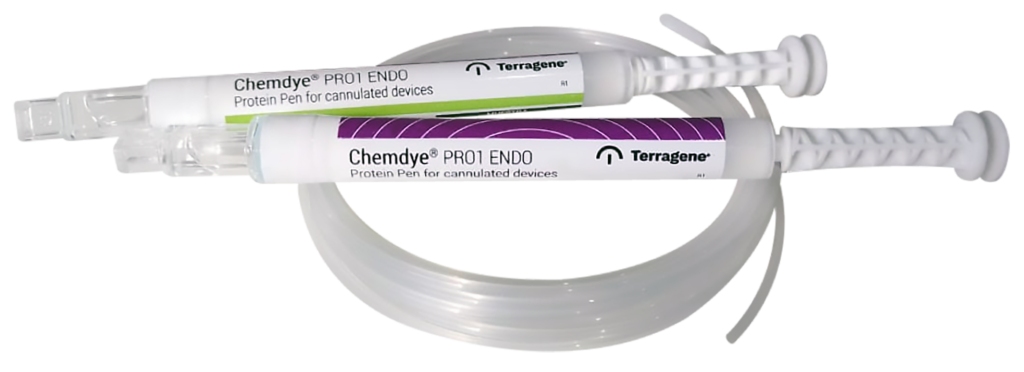
Chemdye® Pro1 Endo – developed for cannulated instruments
Chemdye® Pro1 Endois a quantitative protein testing system developed specifically for cannulated instruments and endoscopes. The system uses long, highly absorbent Chemdye® SWE swabs that enable sampling along the instrument’s internal channels and provide a quantitative result with high sensitivity.
The results are recorded usingthe Bionova® MiniPro auto-readerand can be used for:
- Verification of the Cleaning Process
- Validation and Trend Analysis
- Investigation of Unexpected Results
- Training and Continuous Improvement
- Documentation in Quality Management Systems
Facts lead to better decisions—not assumptions
No cleaning method can be evaluated solely based on how the process is intended to work. For instruments with narrow and complex lumens, objective protein measurement can provide valuable information about the actual cleaning results.
Measurements should not be viewed as an evaluation of a particular method, but rather as a tool for generating objective data. This data can then be used to verify existing processes and provide a fact-based foundation for decisions regarding improvements.
The full study is available for download for anyone who would like to delve deeper into the methodology and results.
More information
The text in this post is based on Terragene’s 2026 multicenter study on the quantitative monitoring of residual protein in cannulated medical devices.
If you have any questions or would like to order products, please feel free to contact us.