
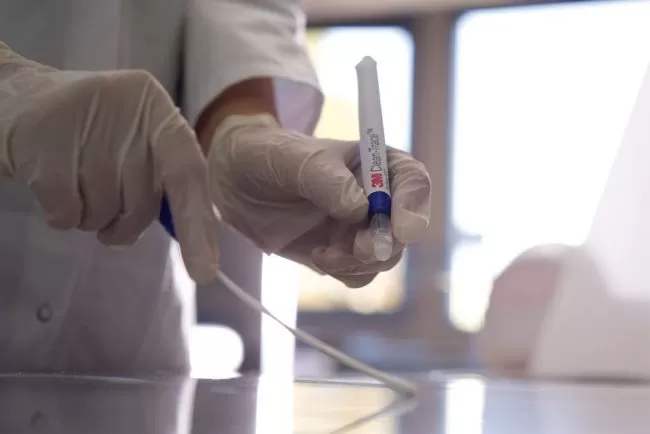
When ATP, it is important to follow the test instructions to obtain reliable and comparable results. Typically, a 100 cm² (10×10 cm) area is swabbed, but sometimes it may be necessary to use a smaller area. This raises the question: How are the measured values affected, and how can they be compared accurately?
Many people believe that a smaller sample area can be compensated for by multiplying or dividing the measured value proportionally. For example, if you swab one-quarter of the standard area (5×5 cm), it is tempting to multiply the result by four to obtain a comparable value. However, this is not a reliable method because ATP is influenced by several factors:
- Uneven distribution of contamination
– Dirt and organic material are rarely evenly distributed across the surface. A small swab area may miss contaminants or yield an excessively high reading if it happens to come into contact with a concentrated area of dirt. This affects reproducibility and makes the test more susceptible to random variations.
– A smaller surface area means that a smaller amount ATP is potentially collected, which affects the sensitivity of the test.- Variations in mopping techniques
– Pressure, motion, and moisture on the mop can lead to different results depending on the surface being mopped.
How should measurement values be compared?
A more scientific way to compare different sample areas is to normalize the results by calculating ATP This is done by dividing the measured value by the size of the sample area. For example, if an ATP yields 200 RLU (Relative Light Units) on a 5×5 cm area (25 cm²), the value per cm² is:
200 RLU / 25 cm² = 8 RLU/cm²
If another test on a 10×10 cm area (100 cm²) yields 500 RLU, the corresponding value is:
500 RLU / 100 cm² = 5 RLU/cm²
This method provides a more accurate comparison than simply multiplying or dividing the results directly, but there are still some sources of error to be aware of.
How should limit values be handled for different sample areas?
The threshold values for ATP are based on tests conducted on a standard surface area.If a smaller surface area is used, the threshold value can be lowered proportionally. However, this is not optimal for the same reasons mentioned above, but it is more acceptable than changing the measured values.A better alternative, however, is to normalize both the measured values and the limit value to ATP for a more accurate comparison.
Recommendations for the accurate interpretation of ATP:
- Always follow the instructions – Wipe a 100 cm² area (or another area specified in the instructions) if possible to ensure the best comparability.
- If a smaller area is used, reduce the limit value proportionally or calculate ATP, but interpret the result with caution.
- Consider the distribution of contamination – A single sample is never representative of the entire surface.
- Use a consistent scrubbing technique – Apply the same pressure and motion every time.
Understanding these factors can lead to more reliable ATP and help you make better decisions regarding hygiene controls.
Would you like to learn more about our hygiene monitoring solutions? Contact us.