
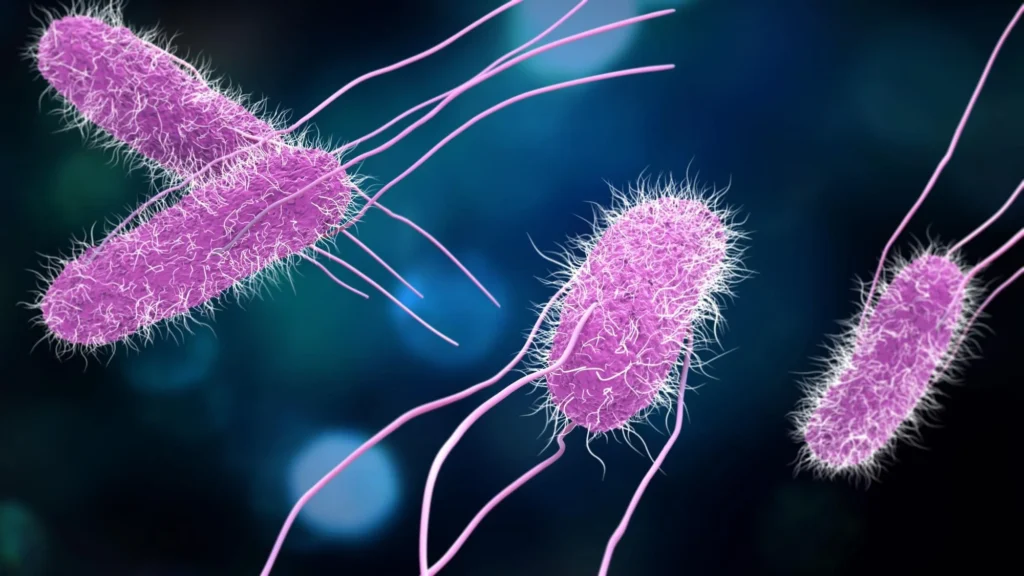
Salmonella a diverse genus of bacteria in the family Enterobacteriaceae. These rod-shaped bacteria are named after the American bacteriologist and veterinarian D.E. Salmon (1850–1915).
Salmonella into two species: Salmonella and Salmonella . Salmonella has primarily been found in reptiles, but it has been observed in humans on a few occasions. Salmonella is further divided into six subspecies; five of these subspecies, like Salmonella , are primarily found in cold-blooded animals. The enterica subspecies of Salmonella (i.e., Salmonella enterica) is the one found in the intestines of warm-blooded animals and is transmitted to humans via the fecal-oral route. To date, more than 2,600 serotypes of Salmonella have been identified, 99% of which belong to the species Salmonella .
Infections caused by Salmonella result in two types of illness. One is salmonellosis, a form of gastroenteritis (“stomach flu”). The other is typhoid fever, a very serious febrile infection that can spread to the spleen, liver, and bone marrow and is caused by Salmonella and Salmonella , which infect only humans. Salmonella primarily in animals such as pigs, birds, and cattle, but also to some extent in water and manure, which is why fruits and vegetables can be a source of infection. Salmonella survive temperatures above 70 °C, but it Salmonella withstand deep-freezing. People are usually infected through food containing the bacteria.
Salmonella be found in the intestines of humans and animals, including birds. It can spread to other environments, such as soil, pastures, and water, through feces. Raw animal products can be contaminated with salmonella infected animals. On a whole cut of meat, Salmonella bacteria may be present on the surface. In ground meat, however, they can be found throughout the meat because it is mixed during the grinding process. Fruits and vegetables can become contaminated when they come into contact with soil, manure, and/or water containing salmonella.
Salmonella primarily Salmonella through food that is eaten without being thoroughly heated. People who have recovered from a salmonella infection can carry the bacteria for some time, which means the infection can be passed on, for example, if they handle food.
The Swedish salmonella monitoring program salmonella that salmonella is very rare salmonella Swedish meat and eggs. The same applies to eggs from Norway, Finland, and Denmark. In other countries, however, it is more common for eggs and chicken, for example, to contain salmonella. Salmonella also been found in imported produce such as leafy greens, sprouts, and spices.
To reduce the risk of salmonella-contaminated food entering the country, Sweden has what are known as salmonella guarantees. These require that there be certification that meat and eggs have been tested for salmonella the products are imported from other EU countries.
In Sweden, less than one percent of all food-producing animals and food products are infected with salmonella, unlike in most other European countries, where it is common for raw chicken and eggs, for example, to be contaminated with salmonella. In most European countries (though not Norway, Finland, and Sweden), Salmonella from eggs and chicken is a particularly serious problem. In Sweden, approximately 3,000 cases are reported annually, of which about three-quarters are contracted abroad.
For more information and news about Salmonella , please Salmonella the following government agencies: