

UV flashlights and UV markers are often used in hand hygiene training, but they have also become a popular method for self-inspection of hygiene areas. This method quickly reveals whether cleaning procedures are being followed and can highlight invisible cleaning deficiencies.
Cleaning and sanitation are crucial for reducing the spread of infection in healthcare and long-term care settings. Quality assurance is therefore conducted routinely, but currently relies almost exclusively on visual inspection. The problem is that many sources of infection and forms of contamination are invisible to the naked eye.
Objective measurement methods for detecting invisible contamination—such as ATP and microbiological analyses —are highlighted in the new Swedish cleaning standard for healthcare (SS 8760014). However, these methods are rarely used by hygiene inspectors, which may be due to a lack of knowledge but is likely even more attributable to financial and practical barriers.
Therefore, there are strong reasons to consider a third method, which is mentioned only in passing in the standard: fluorescence under UV light.
The Black Light
What exactly is UV light? UV stands for ultraviolet and is a type of radiation with a wavelength between 100 and 400 nanometers. In the electromagnetic spectrum, UV lies between short-wavelength X-rays and visible light. Our eyes therefore cannot perceive UV radiation directly.
The purple glow we see from many UV lamps is actually ordinary light emitted at the same time. For this reason, the term “blacklight” is often more accurate than the term “UV light.”
Fluorescence
Many materials “glow” and appear to shine when exposed to UV light. Typical examples include the mineral fluorite, bodily fluids such as urine or earwax, rat droppings, and various products such as paper, laundry detergent, and petroleum jelly. This effect occurs because the material absorbs UV radiation and re-emits it at a longer wavelength that the human eye can perceive.
This phenomenon, known as fluorescence, not only creates a festive “party effect” but also has many practical applications in research, medicine, and technology. In detection, it is used for crack detection, leak detection, crime scene investigations—and, as mentioned, to monitor cleaning procedures.
A simple method, but one with limitations
Illuminating surfaces with UV light is a quick, inexpensive, and simple method for detecting whether fluorescent residues remain. However, it is important to remember that by no means all contaminants fluoresce.
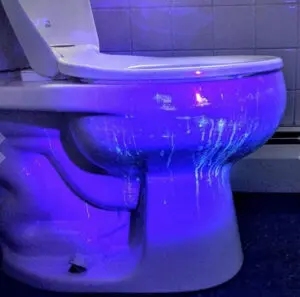
In a restroom setting, traces of chemicals, urine stains, and other bodily fluids are often immediately visible. No UV marker is required for this. However, neither blood nor most bacteria fluoresce. UV light is therefore not particularly suitable for assessing actual infection risks—invisible contaminants are still best detected through microbiological analysis.
On the other hand, UV light can provide valuable insights into whether cleaning procedures are actually being followed, and this is precisely a crucial factor in infection control efforts.
Compliance Check
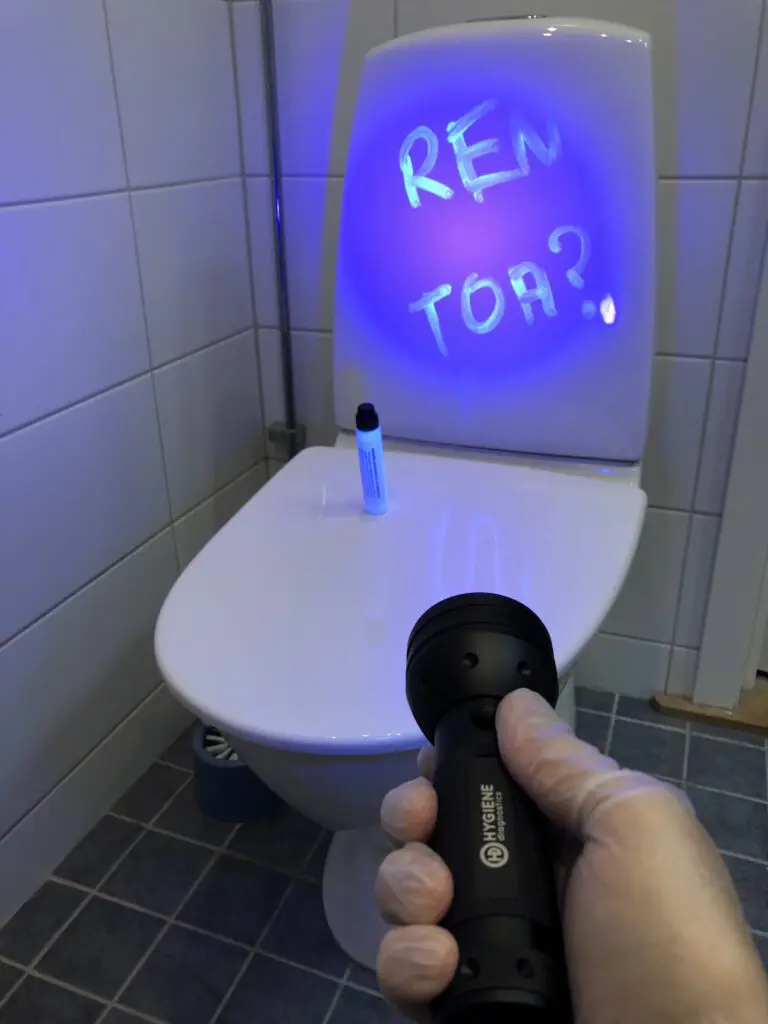
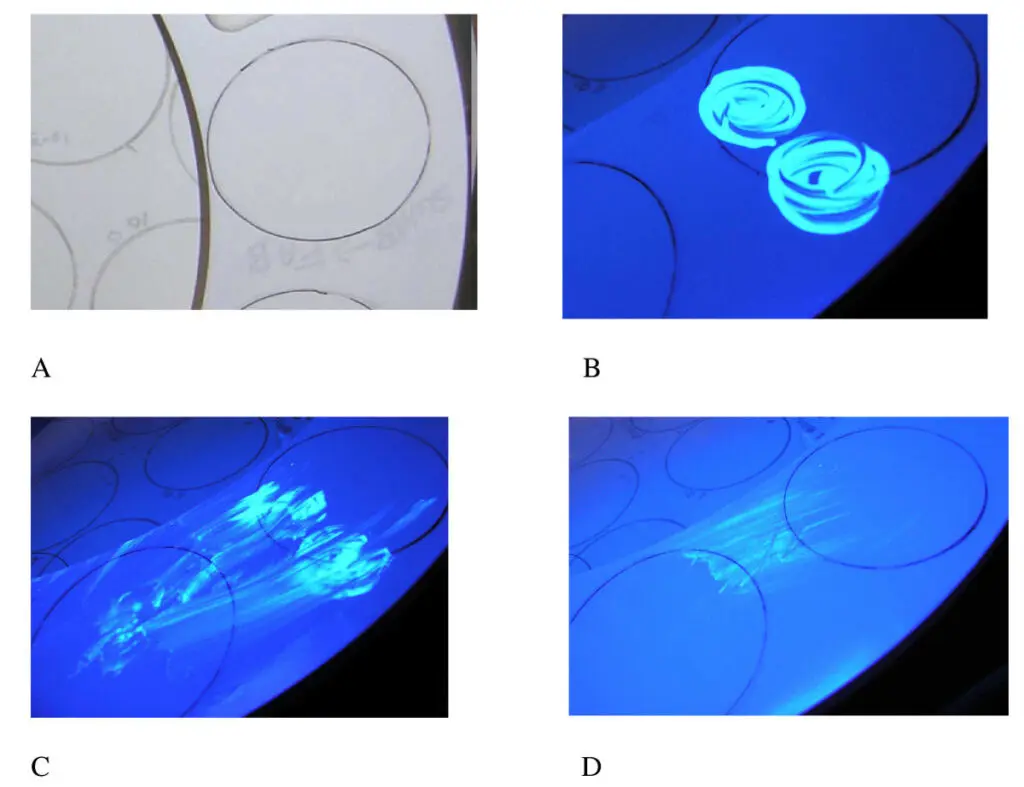
During a so-called compliance check (i.e., a check to ensure that cleaning procedures are being followed), a UV flashlight is used in conjunction with fluorescent markers. There are several varieties on the market, but the most common is Glo Germ™. Using a marker pen containing Glo Germ, surfaces can be quickly marked at a cost of only a few dollars. The purpose of the marking is to check how well the cleaning instructions for wiping are being followed.
Marking can be done on behalf of a client or contractor, but the timing and selection of marked surfaces should always remain unknown to the cleaner. The surfaces chosen for marking should ideally be wipeable, light-colored, flat, and non-porous to function optimally. Good examples include laminated wood, metal, plastic, tile, glass, etc. It is important to note that the UV flashlight used should have a slightly wider beam than usual and should also be bright enough to be effective in rooms with the lights on.
The image below shows how to use the marker in a restroom and how to interpret the results. A good tip before you start marking surfaces is to practice a little first. We recommend testing the marker on various surfaces to see what the results look like after wiping.
In the fields of biology and radiation protection, UV radiation is divided into three wavelength ranges:
- UVA (315–400 nm) – the least energetic, penetrates deeply into the skin.
- UVB (280–315 nm) – higher in energy; causes sunburn, among other things.
- UVC (100–280 nm) – the most energy-rich, destroys DNA, and is used to kill bacteria and microbes.
☀️ The sun emits UV radiation across all wavelengths. However, the ozone layer absorbs all UVC and most UVB radiation.
⚠️ UVA radiation is also carcinogenic to some extent. Unnecessary exposure to all UV radiation should therefore be avoided.
Conclusions
Using fluorescent markers and UV light provides a simple and cost-effective way to verify that cleaning procedures are actually being followed. This method does not replace ATP or microbiological testing, but it helps reduce the subjective element that currently dominates quality monitoring of cleaning and sanitation. It is undoubtedly a tool that every hygiene inspector should have in their arsenal.
If you'd like to try the UV method, you're more than welcome to purchase the products in our online store!
UV Markers & Lamps – Hygiene Diagnostics